Some family issues look simple at first.
A father wants to transfer land to his child.
There is no dispute. No fight over inheritance. No major conflict within the family.
In fact, it is the opposite.
The family is fine. The father and mother live together. They have a child. They recognize each other as a family. No one denies the blood relationship. No one is fighting over the child.
The problem starts when that good intention meets the formal administration of the State.
When land is to be transferred to a child, the Land Office, or BPN, and the Land Deed Official, or PPAT, cannot simply rely on the statement: “This is my child.”
The State needs documents.
Not because the State does not trust the family. But because land is a registered legal right. Every change of name on a land certificate must have a clear legal basis. Who is the previous owner? Who is the recipient? What is the legal relationship between them? What is the basis of transfer? Is the recipient legally allowed to hold that land right? Does the transferor have the legal authority to transfer it?
This is where many families begin to realize something important: what feels “obvious” within the family may not be obvious in the eyes of legal administration.
When There Is Love, There Is a Child, but There Is No State Record Yet
In real life, not every couple follows the ideal order of legal documents.
Some couples are married under religion, custom, or family tradition, but have not registered the marriage with the State. Some couples are of different nationalities, for example a foreign husband and an Indonesian wife, who live as a family and have a child, but their marriage documents are not complete.
As long as there is no problem, this situation may feel safe.
The child can go to school. The family lives normally. Social life continues. Nothing seems disturbed.
But once the matter involves land, banks, inheritance, deeds, immigration, citizenship, or asset transfer, documents become very important.
BPN does not assess whether the family is harmonious.
BPN reads documents.
PPAT also reads documents.
The Civil Registry Office, or Dukcapil, reads documents.
The court reads documents.
So the legal question is not only: “Is this child truly his biological child?”
The questions become more technical:
Has the legal relationship between the father and the child been recorded?
Has the parents’ marriage been registered?
Is the child an Indonesian citizen, a foreign citizen, or a child with limited dual citizenship?
Is the child legally allowed to receive the land?
Is the land registered under the name of the foreign father, the Indonesian mother, or another party?
This is the point that is often missed. Within the family, blood relationship may feel enough. In State administration, blood relationship must be proven by the right documents.
Child Recognition Is Not Merely a Verbal Statement
Many people think that recognizing a child is as simple as saying: “I am the father.”
Socially, that may be enough.
Legally, it may not be enough.
Child recognition is a legal event. Child legitimation is also a legal event. Both are connected to the recording of the child’s status in the population and civil registration system.
This means the factual structure must be reviewed first.
If the parents were married under religion or belief, but the marriage has not been registered by the State, one possible route is to first arrange the late registration of the marriage, or to obtain a court determination as the legal basis for registration.
After that, the child’s status may be arranged through child recognition or child legitimation at Dukcapil, depending on the actual facts of the case.
In some cases, especially where a foreign national is involved, PPAT or BPN may require stronger documents. For example, a court determination confirming the legal relationship between the father and the child, or providing the legal basis for Dukcapil to record the child’s status.
So the focus is not merely on making one written statement.
The focus is to build a proper chain of documents.
From family relationship, to civil registration, to land transfer deed, and finally to BPN.
If this chain breaks in the middle, the transfer of title may be delayed.
Land Cannot Be Treated Like an Ordinary Item
Transferring land to a child is different from giving a watch, a small car, or money in a savings account.
Land has its own legal regime.
There is a certificate. There is a type of land right. There are ownership restrictions. There are taxes. There is a PPAT deed. There is a review process at the Land Office.
This becomes even more important when the family involves a foreign national.
Under Indonesian land law, not everyone can hold every type of land right. Hak Milik, or freehold title, is generally reserved for Indonesian citizens. A foreign national cannot simply own Hak Milik land in Indonesia.
That is why, before discussing a grant or gift of land, the first question must be: whose name is on the land certificate?
If the land is registered under the Indonesian mother’s name, then legally the grantor is the mother as the registered title holder.
If the land is registered under the foreign father’s name, it must be reviewed more carefully. What type of land right is it? How was it acquired? Is there any risk under Indonesian land law? Is he legally allowed to hold that right?
If the land was purchased during a mixed marriage between an Indonesian citizen and a foreign national, it is also necessary to review whether there is a joint marital property issue. In mixed marriages, separation of assets can become very important, especially when the asset is land.
So the issue is not only: “Can the father give land to his child?”
The real issue is: legally, where does the land stand, what type of right is it, and can the recipient legally become the holder of that right?
BPN Needs a Legal Basis for Transfer, Not Just a Family Story
In practice, a transfer of land by way of gift or grant usually requires a deed of grant made before a PPAT.
That deed is the legal basis for the transfer of land rights.
However, PPAT does not work in a vacuum. Before making the deed, PPAT will review who the parties are, what their legal relationship is, whether the certificate is clear, whether the taxes are ready, whether the recipient is legally eligible, and whether the supporting documents are sufficient.
This is where the child’s legal status becomes important.
If a child is going to receive land from a parent, the legal relationship between the child and the parent must be clear.
If the child is still a minor, it must also be clear who has the legal authority to represent the child. If the grantor is also acting as the representative of the child as recipient, there may be a conflict of interest. In certain cases, a guardian mechanism or court determination may be required.
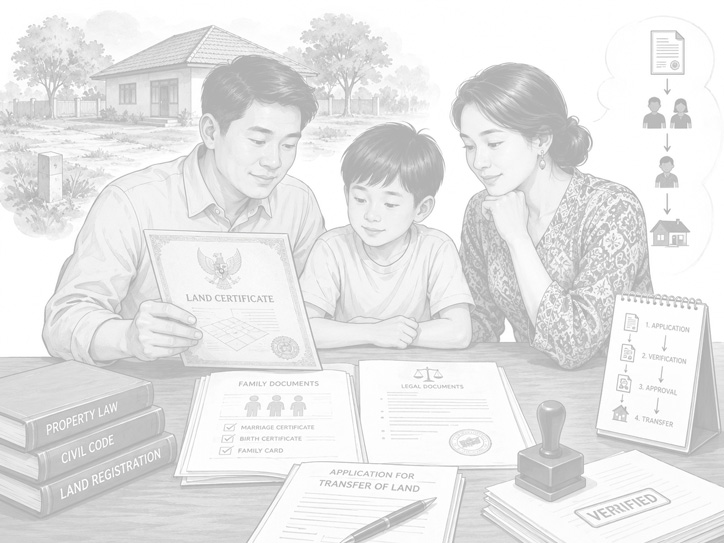
That is why, in cases like this, the process is often not one step, but several steps:
First, check the legal status of the land.
Second, check the legal status of the marriage.
Third, check the legal status of the child.
Fourth, arrange the necessary Dukcapil documents or court determination, if required.
Fifth, prepare the PPAT deed of grant.
Sixth, process the transfer of title at BPN.
If the steps are taken in the wrong order, the family may go back and forth between offices. They come to PPAT, then PPAT asks for Dukcapil documents. They go to Dukcapil, then Dukcapil asks for a court determination. They go to BPN, then BPN asks for a legal basis proving the family relationship.
In the end, the family may feel that the law is making things difficult. In reality, the problem may simply be that the legal sequence was not properly arranged from the beginning.
The Often-Forgotten Perspective: This Is Not Just a Land Issue, It Is a Family Legal Identity Issue
Many people see this kind of case as a land matter.
In fact, the root of the issue is often somewhere else: family status.
The land merely makes the issue visible.
For years, the family may feel that everything is fine. But when an asset needs to be transferred, the State asks: “What is the proof?”
At that point, the family realizes that documents are not just formalities.
Documents are the bridge between lived reality and State recognition.
A child who is clearly a biological child still needs a clear legal status.
A marriage that is socially accepted by the extended family still needs registration so that it can be recognized by the State administration.
Land that is intended to be given to a child still needs a valid legal deed of transfer.
Therefore, in this kind of case, the best route is usually not to look for a shortcut, but to arrange the correct path.
Not to make things complicated.
But to prevent bigger problems in the future.
Three Simple Questions Before Arranging a Land Grant to a Child
Before the family goes to PPAT, BPN, Dukcapil, or the court, there are three simple questions that should be answered first:
First, whose name is currently on the land certificate?
Is it the foreign father, the Indonesian mother, the child, or another party?
Second, what type of land right is it?
Is it Hak Milik, Hak Guna Bangunan, Hak Pakai, or another type of land right?
Third, what is the child’s citizenship status?
Is the child an Indonesian citizen, a foreign citizen, or a child with limited dual citizenship?
These three questions may look simple, but the answers will determine the legal strategy.
If the situation is read incorrectly from the beginning, the documents prepared may also be incorrect. If the documents are incorrect, the transfer of title may be delayed. If the transfer is delayed, the parents’ good intention to provide for their child may turn into administrative confusion.
Closing
Giving land to a child is a good intention.
But in law, good intention must be supported by proper documents.
This is especially true when there is an unregistered marriage, a mixed marriage between an Indonesian citizen and a foreign national, a child whose legal status has not been properly recorded, or land whose legal status still needs to be reviewed.
In this situation, the safest step is not to immediately prepare a private statement, not to immediately request a transfer of title, and not to assume that “child recognition alone is enough.”
It is better to first map the legal position clearly.
Who is the registered holder of the land right? What is the status of the marriage? What is the status of the child? What Dukcapil documents are available? Is a court determination required? Can the PPAT deed of grant be made immediately? Is the child legally eligible to receive the land right?
AIDRLAW can assist in reviewing this initial legal map in a practical and step-by-step manner, so that the family does not take the wrong step from the beginning.
Sometimes, what is needed is not the fastest step.
It is the safest step for the child, for the parents, and for the future of the family’s assets.